

Full-Scale Firestorm

By Annunthra Rangan, Senior Research Officer

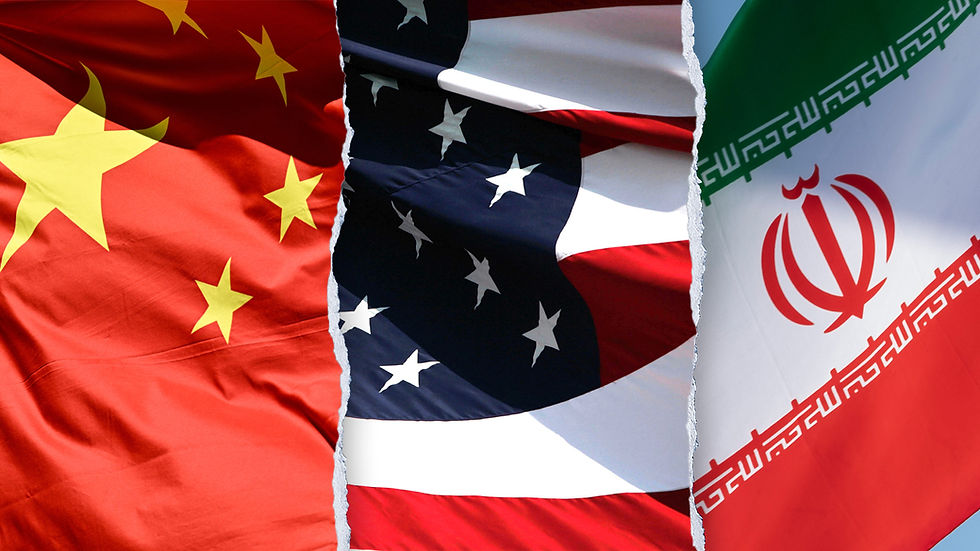
Image Courtesy: Middle East Eye

West Asia is once again on the edge. Following a short but intense conflict between Iran and Israel in 2025, and mounting tensions involving the United States, Tehran is reportedly seeking to replenish and upgrade its depleted missile capabilities. As part of this effort, Iran is close to finalizing a major arms agreement with China, potentially one of the largest weapons transfers in their history. The centerpiece of the reported deal is the acquisition of Chinese CM-302 supersonic anti-ship cruise missiles.
U.S. naval forces, including carrier strike groups, are currently deployed near Iranian waters, a clear signal of Washington’s readiness to deter further escalation. Against that backdrop, the introduction of modern Chinese weaponry into Iran’s arsenal could meaningfully shift calculations, particularly at sea and in the contested chokepoints of the Persian Gulf, Strait of Hormuz and Gulf of Oman.
Cut to February 28 2026, the United States and Israel launched a coordinated military offensive against multiple locations inside Iran, marking a significant escalation in the ongoing West Asia conflict. Missiles and airstrikes struck sites across Tehran and other major cities, with explosions reported near the offices of Supreme Leader Ayatollah Ali Khamenei and at military facilities tied to nuclear and missile infrastructure. U.S. President Donald Trump described the campaign as “major combat operations,” and urged Iranians to rise up against their government, while Israeli officials framed the pre-emptive strikes as necessary to neutralize perceived threats from Iran’s missile and nuclear programs. In response, Iran’s Revolutionary Guard fired missiles and drones toward Israel and U.S. forces in the region, with reports of knock-on impacts at U.S. bases in Gulf states such as Bahrain and Kuwait. Both sides have declared readiness for further combat as airspaces are closed and emergency measures enacted, raising fears of broader regional conflict.
In this context, Beyond anti-ship missiles, sources also say discussions are underway about Chinese air-defense and anti-satellite systems- capabilities that could bolster Iran’s defensive posture while complicating Western military planning.
Currently Iran is considering purchasing the following missiles from China.
The CM-302 Missile
The CM-302 is widely reported to be China’s next-generation anti-ship missile offered for export, based on the domestic YJ-12 family - a fast, sea-skimming weapon designed to penetrate warship defenses. This blend of speed, range, and low-altitude sea-skimming flight means ships have very little warning time once the missile is launched, sometimes under a minute from detection to impact.
Key characteristics attributed to the CM-302 include:
Speed: Capable of supersonic flight (Mach 2–3+), far faster than most subsonic cruise missiles.
Range: Estimated export range of roughly 290–460 km (reports vary by variant and launcher).
Warhead: Heavy payload in the range of 500 kg or more, sufficient to seriously damage or disable large warships.
Guidance: Combination of inertial and satellite navigation with terminal active radar homing to improve accuracy.
Evasive features: Designed to fly low, fast, and unpredictably, making interception by ship air-defense systems much harder.
How Does CM-302 Compare to Iranian Missile Arsenal?
Iran has developed several anti-ship missile systems domestically, though most are slower, lighter, and generally less survivable than the CM-302:
ran operates a range of domestically produced anti-ship and short-range cruise missiles that form the backbone of its maritime strike capability. The Noor cruise missile has a reported range of approximately 30 to 220 kilometers and travels at subsonic speeds around Mach 0.9, using inertial navigation combined with active radar homing for terminal guidance. The longer-range Ghadir extends to roughly 330 kilometers, also operating at subsonic speeds and believed to rely primarily on radar guidance. Similarly, the Qader offers an estimated 300-kilometer range with inertial and radar homing systems. For shorter engagements, Iran fields the Nasr-1, a short-range missile with a range of about 35 kilometers that employs television or terminal guidance. Finally, the Ra'ad cruise missile reportedly reaches up to 360 kilometers, flying at subsonic speeds between Mach 0.8 and 1.0, and uses navigation systems combined with terminal guidance for targeting. Collectively, these systems emphasize coastal defense and sea-denial operations but remain largely subsonic in profile.
Now, these missiles have been operational for years and form the foundation of Iran’s naval strike doctrine. Many are derivatives of older Chinese designs such as the C-802, reverse-engineered with incremental improvements.
Key Differences With CM-302
Speed: Most Iranian missiles cruise at subsonic speeds, giving defenders time to react. The CM-302’s supersonic profile greatly compresses that window.
Survivability: Subsonic missiles are easier for modern naval radars and point-defense systems to detect and intercept. Fast, low-flying supersonic missiles like the CM-302 are much harder to shoot down.
Warhead and Impact: A larger payload on the CM-302 translates to higher lethality against larger warships than most Iranian designs.
Strategic Implications of a China-Iran Missile Transfer
Supersonic missiles like the CM-302 are central to modern A2/AD strategies, denying adversaries freedom of movement in contested waters. For Iran, such weapons could deter or complicate U.S. and allied naval operations in the Persian Gulf and Gulf of Oman, where critical oil shipping lanes and chokepoints sit.
Faster missiles reduce decision time for naval commanders, raising the chance of miscalculation in a crisis. China reportedly also discussed air-defense and anti-satellite systems with Iran, which would deepen military integration.A deal like this would likely run afoul of UN arms controls, exacerbating global tensions.
Reports that Iran may soon acquire Chinese supersonic missiles mark a potentially significant shift in the Middle East military balance. If confirmed, the CM-302 would offer Tehran a more advanced, harder-to-intercept anti-ship capability than most of its current arsenal, undermining regional naval superiority and complicating deterrence strategies.
The announcement by Trump on February 28, 2026, framing the strikes as the beginning of “major combat operations,” signals that the confrontation has moved beyond calibrated retaliation into what increasingly resembles a full-scale regional war. Iran retains substantial defensive and retaliatory capabilities within its immediate neighborhood, particularly through its layered missile arsenal and maritime denial strategy. However, the broader risk now extends well beyond Iranian territory. U.S. naval and air bases across West Asia, including installations in Gulf states, are likely to become primary targets in any sustained escalation, raising the probability of casualties and infrastructure damage across multiple countries.
Compounding the crisis, the Houthi movement has already indicated its intention to intensify operations in the Red Sea, threatening one of the world’s most critical maritime trade corridors. With multiple state and non-state actors signaling involvement, the conflict is no longer confined to bilateral hostilities but is rapidly evolving into a multi-theatre regional confrontation. The strategic, economic, and humanitarian consequences of such an escalation will only become clearer in the coming days, as the scale of military responses, alliance commitments, and global diplomatic reactions unfolds.
(Annunthra Rangan is a Senior Research Officer at the Chennai Centre for China Studies. The views expressed here are those of the author and does not reflect the views of C3S.)



Comments