

China's Quiet Advantage: Watching the World Burn Without Getting Burned

By Annunthra Rangan

Image courtesy: AIIA

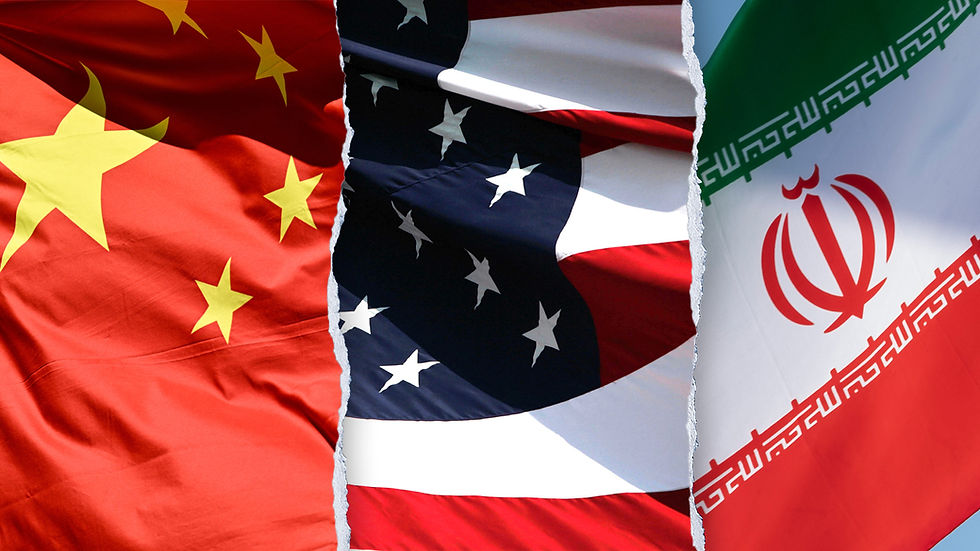
March 28th marks one month since the United States and Israel launched their military campaign against Iran. In the weeks that followed, Tehran has suffered significant losses, including the deaths of key figures within its leadership. Yet despite the scale of the assault, Iran has shown no signs of capitulating and the manner in which Washington has handled this conflict has raised serious questions about the coherence of its strategy.
President Trump's messaging has been, at best, contradictory. On some days, he declares victory. On others, he speaks of ongoing negotiations. The reality, however, is that Iran has not agreed to any terms, has not acknowledged defeat, and is not engaging with what it describes as unreasonable demands. Tehran has publicly stated that it finds the United States unwilling to negotiate in good faith, and that it sees no basis for a ceasefire on the terms being presented.
This contradiction at the heart of American foreign policy is not entirely surprising. Since taking office in January 2025, the Trump administration has consistently opted for pressure and confrontation over diplomacy. From sweeping sanctions against multiple countries to its ongoing tensions with Venezuela. A clear pattern has emerged: this is an administration that views force as a first resort, not a last one.
What makes the situation harder to justify is the double standard on full display. The United States has never held Israel to the same standards it applies to others in the region. Israel's nuclear arsenal goes unacknowledged in official discourse. Its military campaign in Gaza, which drew widespread international condemnation, has now extended toward Lebanon, with Israeli officials openly stating their intent to replicate what was done in Gaza. The United Nations, an institution designed precisely to prevent such escalation, has remained largely ineffective. A failure that many observers argue reflects deep structural bias in how international law is applied.
Iran, for its part, has been under American sanctions for 47 years. It has outlasted multiple waves of economic pressure, political isolation, and military threats. And yet, it continues to hold its ground. When Iran moved to take control of the Strait of Hormuz– one of the world's most critical maritime chokepoints, through which a significant portion of global oil supply passes, it sent an unmistakable signal. The strait remains restricted. That move was not simply a military maneuver; it was a declaration of regional authority. The UAE may have its diplomacy, Saudi Arabia its wealth, and Israel its technological edge. What Iran has demonstrated, repeatedly, is staying power.
The broader consequences of this conflict extend well beyond West Asia. Restricted access through the Strait of Hormuz has disrupted global trade and energy markets. Every country dependent on that corridor feels the impact. This is not a contained regional dispute. It is a conflict with global economic ramifications that continue to deepen with each passing week.
As for who is winning: no one is. The United States has not achieved its stated objectives. Israel has committed to a prolonged campaign with no clear endpoint. Iran is absorbing enormous pressure but is far from broken. All three are depleted in different ways: financially, diplomatically, or militarily.
The country that stands to benefit most from all of this may be one that has said nothing at all. One East Asian power has watched quietly, made no declarations, taken no sides, and continued pursuing its strategic interests without distraction. In a conflict defined by noise, that silence is perhaps the most calculated position of all. And in the long arc of geopolitical competition, that kind of patience may prove to be worth more than any battlefield claim.
No points for guessing the country. If there is a name for that kind of silent, strategic patience, it is China.
China's position amid the current conflict is one of deliberate steadiness. It has maintained functional diplomatic and economic ties with Iran while carefully avoiding any public stance neither condemning the attacks nor expressing solidarity. This is not a passive posture. It is a conscious strategic choice, rooted in a clear-eyed understanding that involvement of any kind, even at the level of rhetoric, carries costs that far outweigh any short-term geopolitical signal Beijing might send.
That restraint, however, does not mean China is without pressure. It carries a substantial set of unresolved challenges closer to home. Contested borders, uneasy relationships with several neighboring states, and an increasingly tense strategic environment across the Indo-Pacific. Beijing operates in a region where reliable partnerships are scarce and potential flashpoints are numerous. Extending itself into a conflict far from its immediate sphere of interest, even diplomatically, would stretch its attention and credibility at a moment when both are better conserved.
The economic case for staying out is equally compelling. China's economy, despite its scale, is managing real structural headwinds. Any form of military entanglement, whether direct or through association, risks triggering sanctions, fracturing trade relationships, and undermining the financial stability that gives China its global leverage in the first place. Military strength and advanced infrastructure are strategic assets only as long as the economy behind them remains sound. Beijing understands that better than most.
And so it watches. It trades, invests, and builds its influence through channels that carry no risk of escalation. Whether one views this as strategic brilliance or simply careful self-interest, the outcome is the same: while the powers directly involved in this conflict drain their resources, test their alliances, and absorb the costs of prolonged war, China moves forward – steadily, quietly, and entirely on its own terms.
While the United States, Israel, and Iran exhaust themselves in an increasingly costly conflict, one country continues to benefit from the disorder without firing a single shot – China.
Beijing's stable relationship with Tehran has kept its access to the Strait of Hormuz largely intact. More significantly, Iran has expressed a clear interest in trading oil in Chinese yuan rather than the US dollar. This is not a minor development. The petrodollar system has been the backbone of American financial dominance for decades, and any credible move away from it strikes at the foundation of that dominance. Washington knows this, which is why countries exploring alternative currencies for trade have consistently found themselves in the crosshairs of American economic and political pressure often without warning.
What China wants from the United States is specific and well-considered. Beijing does not seek a collapsed America. It wants a United States that remains stable enough to keep global markets functioning but no longer influential enough to dictate the terms of China's rise. Under Xi Jinping, that outcome is closer to reality than it has been at any point in modern Chinese history. Yet this is precisely where Beijing's challenge deepens because an unstable, erratic United States is not the same as a weakened one. The so-called superpower that is losing confidence but retains unmatched military capacity is, in many ways, more dangerous than one at its peak. Chinese leadership understands this. What concerns Beijing is not American strength but American unpredictability.
China's own rise was built on the very international system it now quietly works to revise. Open shipping lanes, dollar-denominated trade, expanding global markets, and multilateral institutions– China exploited all of these while simultaneously building alternatives around them. That dependence has not disappeared. China imports roughly 70% of its crude oil from overseas, with about a third of that supply transiting the Strait of Hormuz. Since the war began, gasoline prices in China have risen by around 10% notably less than the approximately 25 percent spike seen in the United States partly because Beijing holds the world's largest strategic petroleum reserve, covering several months of domestic demand. In the short term, China is insulated. In the long term, a prolonged conflict that damages energy infrastructure across the Gulf would be a serious threat to Chinese economic stability.
The risks extend beyond energy. China's export sector accounts for roughly a fifth of its GDP, and nearly all of it moves by sea. Shipping disruptions, rerouting costs, and rising insurance premiums translate directly into economic pressure at home. Slower global demand, driven by higher energy prices, compounds the problem. None of this serves China's interests. Beijing is preparing for a more turbulent world, but preparation is not the same as preference. China does not want instability. It wants to operate within a predictable system on its own favorable terms.
That concern is now showing up in official planning. Beijing has set its lowest growth target in decades in its latest Five-Year Plan, acknowledging that the global conditions that powered its rise are becoming less reliable. Its pivot toward advanced manufacturing, what it calls "new quality productive forces", requires stable energy supplies, reliable access to critical minerals, and functioning global knowledge networks. In a volatile environment, the very sectors meant to secure China's future become more exposed to disruption.
Some analysts have suggested that with the United States stretched thin across multiple fronts, this could be China's moment to move decisively on Taiwan. That argument does not hold up under scrutiny. China's strategic calculations are not driven by opportunism alone. At this juncture with global trade under strain, financial markets unsettled, and three concurrent conflicts creating systemic uncertainty, launching a war would undermine the very foundations of the economic strength China has spent decades building. Beijing's preferred methods remain incremental: industrial leverage, market access as a diplomatic tool, gradual financial infrastructure built around the yuan, and quiet influence operations. China seeks to accumulate advantage, not detonate the system it still depends on.
There is, however, one area where this conflict may genuinely accelerate Chinese interests: the slow erosion of petrodollar dominance. Iran is reportedly in discussions with several nations to permit passage through the strait on the condition that payments are made in yuan. A broader shift away from dollar-denominated oil trade would give China's long-standing push for yuan internationalisation a geopolitical tailwind it has never had before. If the petroyuan gains traction from this conflict, that may be the most consequential and lasting outcome for Beijing– achieved without a single act of aggression.
China is also well-positioned for what comes after the war. Its strong relationships across the Gulf, combined with its capacity to finance and build large-scale infrastructure, place Chinese companies at the front of the line for regional reconstruction: ports, energy facilities, desalination plants, and more. As Sun Tzu observed, the highest form of strategy is to achieve one's objectives without resorting to war. Beijing has internalized that principle. It will not trade decades of careful, compounding work for a single moment of confrontation.
What happens next in the Iran-US-Israel conflict will shape the region for years. But China's trajectory, for now, is not determined by that conflict. It is quietly shaped by it. That is precisely how Beijing wants it.
(Annunthra Rangan is a Senior Research Officer at the Chennai Centre for China Studies. The views expressed here are those of the author and does not reflect the views of C3S.)


Comments