

Trump-Xi Summit 2026: Geopolitical Messaging

How the 2026 Beijing summit reshapes risks and opportunities for regional middle powers
By Rohit KA and Dr. Adityanjee

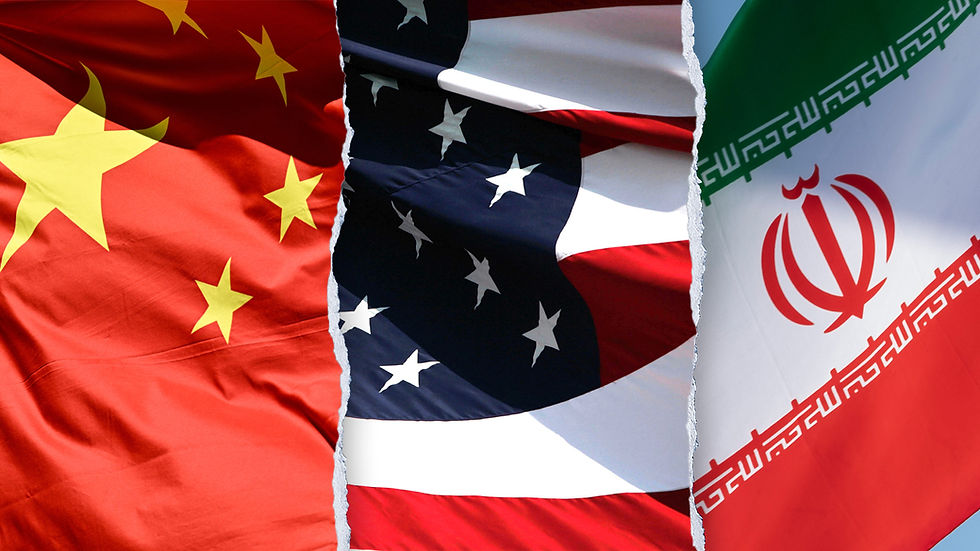
Image Courtesy: Asia Times
A summit shaped by Iran, trade, and Taiwan
The US President Donald Trump met Chinese President Xi Jinping in Beijing on May 14 - 15, 2026, in the first visit by a US president to China in nearly a decade. This was Trump’s first state visit to China in his second term. The US agenda focused on stabilizing a strained relationship amid disputes over trade, technology, Taiwan, and the ongoing Iran war, with low expectations for major breakthroughs but hopes for modest deals on tariffs, aircraft sales, agricultural purchases, and rare earths. The Chinese government signaled that the summit was about managing rivalry, not resolving it, using the visit to project stability while each remains preoccupied, Washington with Iran and Beijing with economic headwinds and regional assertiveness.
Deliverables to the US and China’s Power Projection
Trump and Xi met in Beijing for a two-day summit focused on trade, tariffs, and rare earths supplies, Taiwan, technology, and the war involving Iran. The optics of the meeting were very unusual. Both sides were trying to cool tensions without abandoning competition. They explored extensions of trade truces, arrangements on critical minerals, and ways to avoid accidents between their militaries, especially around Taiwan and the South China Sea. Xi publicly warned a supplicant and fawning Trump that mishandling Taiwan could “jeopardize” the entire US - China relationship, underlining how close the region sits to potential crisis. The very mention of managing the Thucydides’ trap by Xi Jinping was a very clear message to the US and the international community that the days of a unipolar hyperpower are over. The highlight of the visit was a personal tour of the Zhongnanhai given by Xi Jinping to Donald Trump. The message was clear! The divine emperor from the Middle Kingdom was receiving a barbarian chieftain from a vassal state repeatedly paying his respects and singing hosannas in the glory of the divine emperor. No important bilateral economic agreements were signed. Xi Jinping bluntedly told Trump that the US economy is in grave decline. China refused to bail out the US in resolving its impulsive war of convenience with Iran. During the summit, China unexpectedly denounced the US treaty ally Japan for raising the temperature across the Taiwan Strait. China also openly castigated the QUAD as a security alliance directed at containing China which is somewhat rich. The US side failed to remind China about its own record of creating security alliances like the CRINK (China, Russia, Iran and North Korea), SCO (Shanghai Cooperation Organization) and the PRIC (Pakistan, Russia, Iran and China).
A High - Stakes Summit in the Indo - Pacific’s front yard
For the Indo - Pacific, this matters because the region, stretching from the Indian Ocean to the western and central Pacific, contains key sea lanes and many of the world’s largest economies, so any US - China shock quickly translates into higher security risks and economic volatility. When tensions spike, countries like Japan, India, Indonesia, Vietnam, and Australia face pressure to take sides and suffer directly from trade disruptions or military incidents near their waters.
US - China relationship and Indo Pacific
The summit’s most immediate benefit for Indo - Pacific states is a temporary reduction in short term risks, which is less chance of trade war escalation and lower odds of a military incident turning into a wider conflict. If Washington and Beijing can reaffirm hotlines, codes of conduct at sea, and regular senior level dialogue, the risk of miscalculation in crowded areas such as the Taiwan Strait and South China Sea falls. That is a direct strategic gain for nearby states, which includes nations such as the Philippines, Vietnam, Taiwan, which would be the first to feel the consequences of any US-China clash.
Diplomatically, when the US - China temperature is lower, regional forums such as ASEAN, the East Asia Summit, the Shangri La Dialogue and Indian Ocean bodies can move from crisis management to agenda - setting. Indo-Pacific nations can then push their own visions like ASEAN’s “Indo-Pacific Outlook, India can focus on “Security and growth of all regions (SAGAR), Japan’s evolving “Free and Open Indo-Pacific” without every initiative being seen as a direct move in US - China competition.
Strategic hedging as the main geopolitical gain
Most of the countries in the Indo - Pacific are middle powers, they cannot match the US or China but can still shape outcomes, especially when they act together. Research shows that many of the countries such as Singapore, Indonesia, Vietnam, India, Japan, Australia follow the principle of “strategic hedging" strategies rather than pure alignment with one side.
Strategic hedging means keeping strong security ties with the United States while also maintaining deep economic connections with China, plus diversifying towards Europe and other partners. Studies highlight concrete techniques, limiting dependence on any single trading partner, buying arms from multiple suppliers, and building domestic institutions that make it harder for any great power to capture policy.
A more predictable US - China relationship after the summit makes hedging easier and more effective. With less pressure to “choose”, countries like Indonesia, Vietnam, and South Korea can deepen security exercises or technology cooperation with the US and its allies while simultaneously expanding trade and infrastructure engagement with China. This turns great power rivalry into a source of leverage, both Washington and Beijing must compete to be attractive partners, offering better financing, greater access to domestic markets, and geopolitical respect for sovereignty.
Indo Pacific countries and their perceptions
For India, a calmer US - China climate means it can expand defense, technology, and maritime cooperation with the US and other partners through mechanisms like the QUAD, while keeping economic and diplomatic channels with Beijing open where interests overlap. This supports India’s aim to be a “leading power” and net security provider in the Indian Ocean, rather than a junior partner in someone else’s alliance system.
For Japan and Australia, the advantage lies in reassurance and continuity. If the summit showed that the US will stay engaged militarily in Asia while seeking economic de - escalation with China, both countries gain confidence to invest steadily in deterrence and regional initiatives, from AUKUS to maritime domain awareness and infrastructure funding. They benefit from lower risk of conflict near their sea lanes, plus more stable global markets that support their export driven economies.
For ASEAN and Indonesia, a quieter US-China relationship makes their preferred approach “inclusive” Indo-Pacific order, open to all partners, more credible. Indonesia’s “Global Maritime Fulcrum” strategy, for example, is designed to balance US and Chinese initiatives (Free and Open Indo - Pacific and Belt and Road) and turn the country’s geography into diplomatic leverage rather than vulnerability. In a less tense environment, ASEAN members can push harder for their own connectivity plans, codes of conduct in the South China Sea, and diversified economic ties.
Smaller Indo - Pacific states, from Sri Lanka and Maldives in the Indian Ocean to Pacific Island states will also gain by this summit by being able to get multiple partners for infrastructure, Climate finance, and security assistance without intense binary pressure. Their value increases when both Washington and Beijing want friendly ports, votes in international forms, and legitimacy for their regional visions.
Using the Window - From temporary calm to lasting advantage
The summit will not remove the underlying drivers of US - China competition; those stemming from structural issues like China’s rise, US concerns over technology and security, and disputes over Taiwan and maritime claims. The real geopolitical advantage for Indo-Pacific countries lies in how they use the breathing space the summit provides for easing tensions.
If the regional government treats this lull as an opportunity to diversify trade and investment beyond both the United States and China, they can reduce their vulnerability to economic coercion or sudden policy shifts from either side. At the same time, by strengthening regional institutions and legal norms on navigation, connectivity, and digital rules, they can help build a rules-based environment that constrains great-power behavior and protects the interests of smaller and middle powers. Finally, if Indo - Pacific states use this period to build flexible security and technology partnerships that do not depend on any single leader or administration, they can create resilient networks that endure domestic political changes in Washington or Beijing.
Future implications for the Indo-Pacific
The temporary calm created by the Trump-Xi meeting is unlikely to last, this is because the underlying strategic competition between the United States and China over rules, technology, and regional influence will continue to intensify. As both powers adapt their Indo - Pacific strategies, they are likely to lean more on institutional, economic and technological tools rather than outright military confrontation, creating a long-term environment of “managed rivalry” rather than genuine partnership. Already, both Japan and the Philippines have signed a bilateral maritime border accord resulting in a volley of pungent verbal diarrhea from China. Japan, India and Australia as resident naval powers must use this strategic window to deepen the strategic and security cooperation in the Indo-pacific region.
For Indo-Pacific countries, this trajectory means that today’s breathing space is best seen as an investment window: the choices they make now about diversification, regional rule making and flexible coalitions will determine whether they remain rule takers or be rule shapers in a more multipolar order. If they can embed their preferences in institutions, norms and networks, while the great powers are temporarily restrained, future summits, whoever sits in Washington or Beijing, will have to take regional agency seriously rather than treating the Indo-Pacific as a mere backdrop to a US-China “G2”. This opens a strategic window for India to establish and assert herself as a major security provider in the Indo-Pacific region while both US and China are managing their rivalry without any hot war in near future.
A lot of holy water has flown already, indeed, through the Potomac and the "Huang He" (黄河) rivers since this recent but long forgotten summit which formalized the emergence of the communist China as the prime candidate for replacing the reigning but weakened hegemon. Optics don’t lie; political leaders do!
(The views expressed are those of the authors and do not reflect the views of C3S.)


Comments